
How is Impact Planned?
Based on an established Problem, Impact is a change in an outcome caused by an organisation through its use of Resources for Activities and generation of Outputs. An impact can be positive or negative, intended or unintended.
Theory of Change/
Logical Model of Impact
Example Water Sources

Initiate Your Logical Framework
You can start this process from any step. If you are an existing organization creating outputs, build your logical framework around the existing processes by identifying which positive and negative outputs and impacts you are already creating. Use the logical framework process to plan any adjustment of your activities and outputs in order avoid harm in the future, increase the benefit to stakeholders and even create impactful solutions.
However, users that are setting up a new impact program start with the Problem Statement and then define the Goal. Based on the problem and goal the desired long term impacts are formulated. Later they describe the steps (rationales, assumptions, required resources/inputs, planned activities, planned outputs and outcomes) that will result in the impact that the goal sets out to achieve. Consider the required ESG policies of your organization and your supply chain. Furthermore it is important to assess the risks that negative effects and negative impacts might occur as well as your mitigation approach. This will more often then not be an iterative process. Thus, often the theory of change is shown in the format similar to the graphic presentation below.
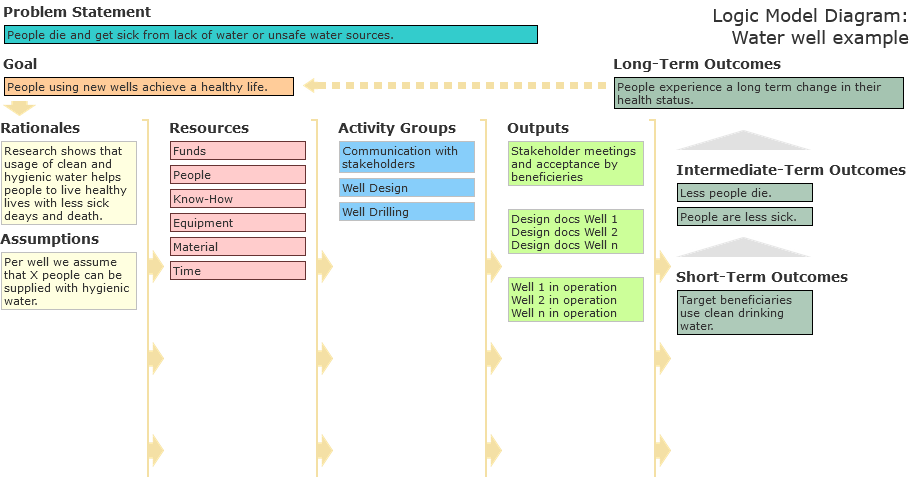
A handy guidebook on thinking through a theory change is found at https://www.phineo.org/uploads/Downloads/PHINEO_Social_Impact_Navigator.pdf. We recommend you to check it out.
Theory of change and business planning: At Invest-In-Impact we consider that the theory of change should be combined with business planning. See below.
A PROBLEM worth solving
At Invest-In-Impact we decided to think in boundary models where the ecological ceiling and the social foundation provide the space where all humans could flourish and develop. However, if we as a collective use too many resources we "overshoot" the ecological ceiling and live beyond our means with for example climate change and air pollution negatively affecting us.
At the social boundary resources are often not equally distributed and some of us experience a "shortfall" and thus do no live on a stable social foundation. This is nicely documented in the "doughnut" economic model by the Doughnut Economics Action Lab which is presenting humanity´s selfie below. It shows clearly that we are currently living far outside the comfortable space within the social and ecological boundary. Despite the fact that some boundaries might currently not yet be quantified or not exceeded globally, we are on the way there and on local and regional levels we are already overshooting in many parts of the world.

The social foundation is modelled upon the sustainable development goals while the ecological ceiling is based on the nine planetary boundaries defined by Earth scienties.
A good start for the problem statement is, similar to business planning, to think of the challenges and needs of the people in your area of your services and analyse how your products and services can alleviate them. A helpful tool is a problem tree analysis (find an example here) which, based on the identified core problem, makes the root causes and the effects on the stakeholder or society visible. From a problem tree it is possible to "reverse engineer" the goals and objectives of your project, services, intervention, etc. This is similar as you would derive from the needs of customers derive your value proposition in form of teylor-made products and services.
Four classes of goals - IMPACTS
At Invest-In-Impact we follow the standard definition of Impact as for example outlined in Phineo. Desired changes at the societal level are designated as impacts, while results at the target-group level are called outcomes. Therefore, it is common to say that a project seeks to contribute to impacts, but achieves outcomes. the project
has less influence on results at the impact (societal) level than it does on the results at the outcome (target-group) level, because changes in society are influenced by many
other factors in addition to the project itself as is evident by the picture on top showing a theory change.
At Invest-In-Impact we also like the Impact Management Project and the norms laid out by them since they provide a uniform language for understanding goals and impacts and provide a structure for this complex issue. It can be used by purely socially and environmentally driven NGOs as well as for profit businesses. The define four levels of impact that accomodate different motivations of organisations. Financial-only interest which might result in doing harm in all or potentially only one activity of the organisation, act to avoid harm, benefitting stakeholders and contributiong to solutions. For impact the ABC intentions at the outcome level are the important guidance. It is still possible to the aim of the ABC goals at the same time has making a profit. You just have to make sure that none of your activities "Does Harm" to people or the society.
By using their guidance you can categorize your venture and/or organizations level of ambition and to communicate it accordingly. However, it is important to assess all the impacts that you have on the world and people in order to allow a full informed categorization. An example for the most basic assessment can be found here.
Financial-only
Responsible
Sustainable
Impact
Investment Profile - Impact Interest

What OUTCOMES will generate the desired IMPACTS?
Five Dimensions
After getting clear about the goals you need to specify the five dimensions of the change for each of the outcomes your venture/organization/project has on the world.
Here it is of course important to understand your intended positive outcomes but also to understand the unintended negative outcome your products or services generate. Consider that you are an organization that provides educational services then "Access to education" might be your main intentend outcome. You will hower most likely also need to consider whether you provide access to "underserved communities", the outcome on "Gender equality", whether the services are "affordable" all at the same time considering the outcome on "Job Creation" "Employees" (Inclusion, diversity). Last but not least you will need to consider whether you avoid harm to the environment by limiting resource consumption ("GHG emissions") and waste and whether you pay your taxes as contribution to society. A lot of these aspects do not yet follow a common rule set and will therefore be assessed by different groups at least slightly differently. It is important however to be as transparent as possible.

Detailed impact and outcome dimensions
WHAT
Description
1. Outcome(s) and levels in period
Describe the outcome(s) and the level of outcome experienced by the stakeholder when engaging with the impact provider (enterprise, organisation, etc). What impact are they experiencing?
2. Outcome threshold
The level of outcome that the stakeholder considers to be a positive outcome. Anything below this level is considered a negative outcome. The outcome threshold can be a nationally or internationally agreed standard. See a deteailed descritpion about the ABC at outcome level here.
3. Importance of Outcome to stakeholder
The stakeholder´s view of whether the outcome they experience is important (relevant to other outcomes). Where possible the people experiencing the outcome provides this data, although third party research may also be considered. For the environment, scientific research provides this view.
4. SDG or other global goal
The Sustainable Development Goal target or other global goal (see e.g. the thresholds laid out in the doughnut economics) that the outcome relates to. An outcome might relate to more than one goal.
WHO
Description
5. Stakeholder
The type of stakeholder experiencing the outcome.
6. Geographic boundary
The geographic boundary where the stakeholder experiences the social and/or environmental outcome.
7. Outcome level at baseline
The level of outcome being experienced by the stakeholder prior to engaging with, or otherwise being affected by the impact provider (enterprise, organisation, etc).
8. Stakeholder characteristics
Socio-demographic and or beahvioral characteristics and/or ecosystem characteristics of the staekholder to enable segmentation.
HOW MUCH
Description
9. Scale
The number of individuals experiencing the outcome. When the planet is the stakeholder, this category is not relevant.
10. Depth
The degree of change experienced by the stakeholder. Depth is calculated by analysing the change that has occured between the "Outcome level at baseline" (Who) and the "Outcome level in the period" (What).
11. Duration
The time period for which the stakeholder experiences the outcome.
CONTRIBUTION
Description
12. Depth counterfactual (or Deadweight according to EU/OECD in 2015)
The estimated degree of change that would have happened anyway - without engaging with, or being affected by the impact provider (enterprise, organisation, etc). Performance of peers, industry or local benchmarks, and/or stakeholder feedback are examples of counterfactuals that can be used to estimate the degree of change likely to occur anyway for the stakeholder.
13. Duration counterfactual
The estimated time period that the outcome would have lasted for anyway - without engaging with, or being affected by the impact provider (enterprise, organisation, etc).Performance of peer enterprises, industry or local benchmarls, and/or stakeholder feedback are examples of counterfactuals that can be ised to estimate the duration likely to occur anyway for the stakeholder.
RISK
Description
14. Type of impact risk
Impact risk is the likelihood that an enterprise’s impact on people and planet will be different than expected, and that the difference will be material from the perspective of people or the planet who experience impact. Nine types of impact risks that may undermine the delivery of the outcome.
15. Level of impact risk
The probability that external factors disrupt our ability to deliver the expected impact. The likelihood and severity of the impact risk as well as how much can the risk be mitigated.